Family old videos, whether wedding footage, baby growth milestones, or holiday gatherings, often suffer from low resolution, faded color, and noise after decades of storage. This guide covers the full workflow from digitization to AI repair, helping you bring precious memories back to clear. For the final quality boost, Miaomiao AI offers one-click upscaling to 4K with no download required.
Common Issues with Family Old Videos
Before repairing, it helps to identify what is actually wrong with the footage. Most family videos recorded on tape or early digital cameras share three recurring problems.
Low Resolution
VHS tapes and early MiniDV cameras captured footage at roughly 240p to 480p. On modern 4K screens, this footage looks soft, pixelated, and small, which is the primary clarity problem for family archives.
Color Distortion
Time and improper storage fade magnetic tape, causing color shifts, loss of saturation, and a yellow or blue tint. Color casts also build up across repeated playback and analog dubbing.
Camera Shake
Handheld shooting without stabilization was the norm in consumer camcorders, resulting in jittery footage that is tiring to watch and harder to upscale cleanly.
Family Video Digitization Conversion
If your family videos are still on tape, you first need to convert them into a digital file before any AI repair can be applied. This stage determines the upper quality limit of everything that follows.
Equipment
You will need the original playback device (VCR or camcorder), a capture device (USB capture card or dedicated digitizer), and a computer with capture software. For the best results, use a capture card that supports lossless or high-bitrate recording.
Steps
- Connect the player: Link the VCR or camcorder's RCA or S-Video output to the capture card.
- Set capture format: Choose a high-bitrate codec such as ProRes, DNxHR, or H.264 at 20 Mbps and above to avoid compression loss at the digitization stage.
- Record in real time: Play the tape and capture in real time. Do not pause or speed up the playback.
- Save the master file: Store the captured file as your master archive before any further processing.
AI Repair Family Video Workflow
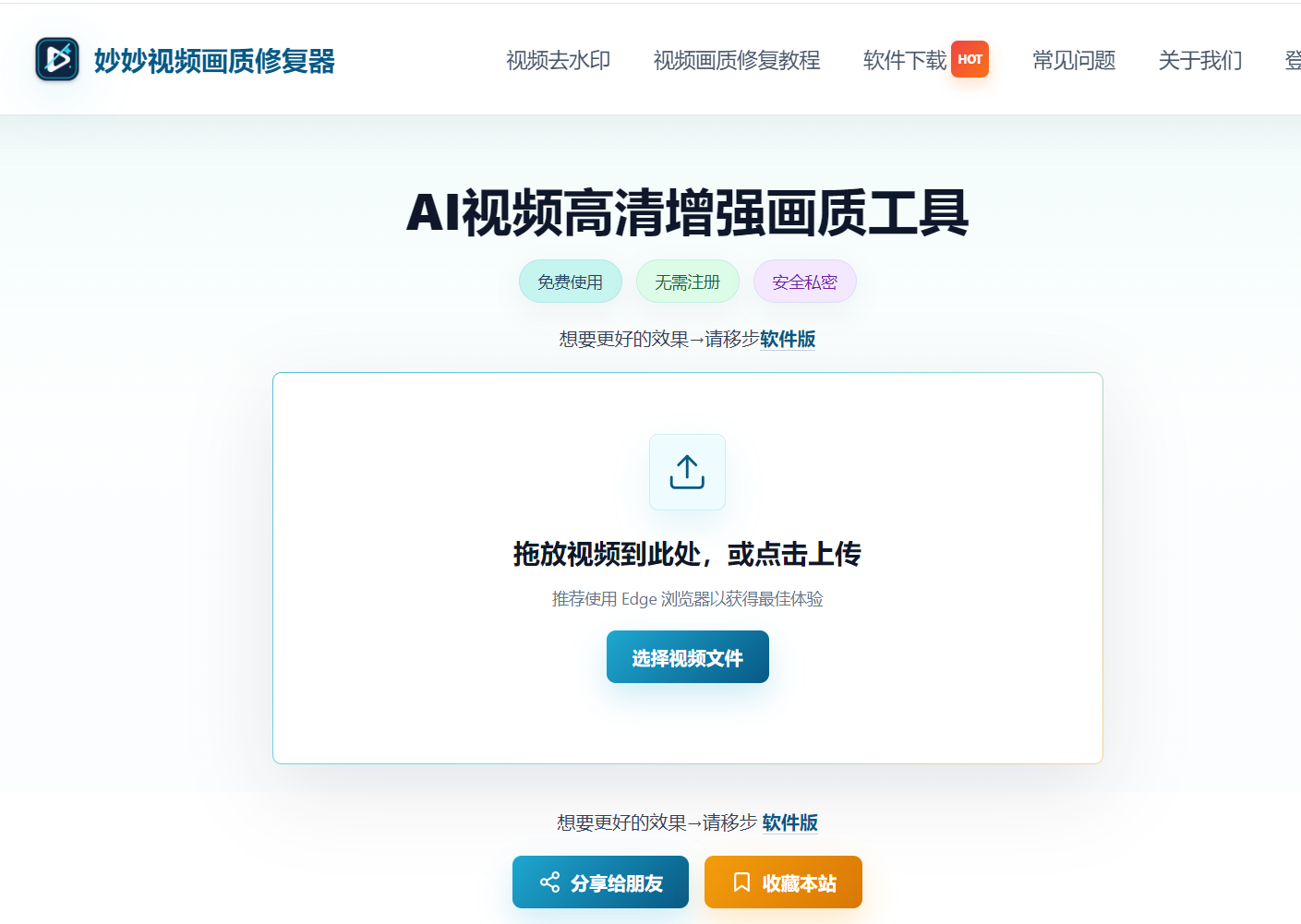
Once you have a digital master file, AI repair can rebuild resolution, suppress noise, and restore detail that the original tape never captured cleanly. Miaomiao AI handles the entire process in four steps.
- Upload the master file: Open the Miaomiao AI Video Upscaler page and drag in the digitized clip.
- Select target resolution: Choose 2K or 4K based on the original quality and your display device.
- Start AI processing: The super-resolution model reconstructs edges and texture frame by frame in the browser.
- Download the restored video: Save the HD result and archive it alongside the original master file.
Repair Effect Comparison
The table below shows the typical before-and-after differences when running a 480p family tape through Miaomiao AI upscaling.
| Metric | Before Repair | After AI Repair |
|---|---|---|
| Resolution | 480p (NTSC) / 576p (PAL) | Up to 4K (2160p) |
| Noise | Heavy analog noise and grain | Smoothed, detail preserved |
| Color | Faded, shifted tint | Balanced and more saturated |
| Clarity | Soft, pixelated on modern screens | Sharp edges, readable faces |
One typical case: a 1998 wedding tape digitized at 480p was upscaled to 4K with Miaomiao AI. After processing, facial features of family members became clearly recognizable on a 65-inch TV, where the original capture had been too soft to identify faces from across the room.
Bring precious family memories back to life with free AI upscaling to 4K
Repair Video Now →Conclusion
Repairing family old videos is a two-stage process: careful digitization to preserve maximum original quality, followed by AI repair to rebuild resolution, color, and clarity. Miaomiao AI makes the second stage accessible to anyone, with no software installation or upload to remote servers required. By following this workflow, you can keep decades-old family footage watchable on modern screens for years to come.
Frequently Asked Questions
Can AI repair really restore a VHS family video to 4K?
AI cannot recover detail that was never recorded, but it can reconstruct plausible edges and texture from the existing signal. Miaomiao AI upscales VHS footage to 4K with noticeably sharper faces and cleaner noise than the original capture.
Do I need special equipment to digitize family tapes?
You need the original playback device (VCR or camcorder), a USB capture card, and capture software. No professional studio equipment is required for home digitization.
Is Miaomiao AI free for repairing family videos?
Yes. Miaomiao AI runs in the browser with local processing, requires no registration, and offers its core upscaling features for free with no watermark on the output.